

How to Train Home Services Sales Reps to Ask for Referrals 

TL; DR Summary: A practical coaching framework for home services leaders — how to diagnose why sales reps hesitate to ask for referrals, standardize the ask across your whole team, and build the habits that make referral requests a consistent part of every customer interaction.

Most home services companies don't have a referral demand problem. They have a training problem.

Your sales reps are already creating the moments that generate referrals — closed jobs, satisfied homeowners, real trust. What's missing isn't opportunity. It's a standardized way to act on it. Some reps ask naturally. Others never bring it up. A few ask so awkwardly that it undercuts the sale they just closed.

That inconsistency isn't a personality problem. It's a coaching gap. And like any sales skill, asking for a referral can be diagnosed, scripted, and drilled into a habit — the same way you'd coach a pitch or an objection-handling flow.

This framework is built directly from the referral tactics GTR's Dustin Posey walked through in our Sell More. Refer More. Grow More: The Sales Rep Playbook webinar. If you manage a sales team, here's how to turn that content into something you can actually coach.

Step 1: Diagnose Why Your Reps Aren't Asking

Before you standardize anything, figure out where the breakdown actually is. In ride-alongs or 1:1s, listen for which of these your rep is running into:

  • They don't know when to ask. They either forget entirely or wait until the very end, when the homeowner is already mentally out the door.
  • They don't have language that feels natural. They default to "Do you know anybody?" — a closed-ended question that makes "no" the easiest possible answer.
  • They treat the ask as an add-on, not part of the pitch. If referrals never come up until after the close, it will always feel like an extra favor instead of a natural extension of the conversation.
  • They don't know what to do with hesitation. A homeowner pauses or pushes back once, and the rep drops the subject entirely instead of having a next line ready.

Each of these is fixable — but they need different coaching. A timing problem and a scripting problem look the same from the outside (the rep just "isn't asking"), but they require different fixes. That's why the next step is standardizing the system, not just handing reps a line to memorize.

Step 2: Standardize the Ask Around Three Coaching Pillars

Rather than teaching six disconnected tips, group the referral ask into three coachable pillars. This is the same six-tactic framework from the webinar — organized the way a manager would actually drill it in training.

Pillar 1: Plant the Seed

Tactic — Ask while the experience is fresh. The right moment to ask is before you leave the driveway, not three weeks later via an automated email. Trust is highest immediately after you've delivered value — and that's true even when a homeowner says no to the project but still respects how you handled the visit.

Tactic — Plant the seed early. Don't save the referral conversation for the very end. Introduce it mid-pitch, so it never feels like a surprise:

"One other thing I'll show you before I leave today is our referral program. We reward homeowners who introduce us to friends or family who could benefit from the same kind of conversation we're having today."

That's the whole seed. No ask yet — just awareness. When the rep circles back later, they're continuing a conversation instead of starting an awkward new one.

📹 Coaching clip: "Unlock Referrals: Plant Seeds Early, Ask Smart, Get Leads" — a short clip from the live webinar covering this exact pillar — is a good one to drop into a team training channel or the start of a sales meeting.


Pillar 2: Sell the Experience

Tactic — Make the ask natural. Coach sales reps out of "Do you know anybody?" entirely. Replace it with an open-ended prompt that sells the experience, not the product:

"You've spent some time with me today. Hopefully this was helpful. Who comes to mind that might benefit from having the same kind of conversation?"

If a sales rep needs a fallback line for a homeowner who's drawing a blank:

"Usually when I ask that, somebody immediately thinks of a neighbor, a family member, or somebody at work. Who came to mind for you?"

Tactic — Frame the incentive correctly. If your company offers a referral reward, sales reps should lead with the value of the introduction, not the payout. "Give me three names, and we'll pay you" reads as transactional. Instead:

"We want to reward you for making the introduction, but the bigger idea is simple. If somebody you know could benefit from the same experience, we want to make it easy for you to connect us."

Pillar 3: Remove the Friction

Tactic — Follow up while it's warm. Momentum is everything. A referral that sits uncaptured until "Friday afternoon" loses most of its value. Coach sales reps to log it on the spot, understand where it sits, and take the next action immediately — and to thank the advocate, who just put their own credibility on the line.

Tactic — Remove the fear when they hesitate. Hesitation isn't a dead end; it's a coaching moment. When a homeowner says something like "I don't want you blowing up my friend's phone," sales reps need a ready response:

"Totally understandable. That's exactly why we have a consent process. We're not going to start calling them just because you gave us their information. They'll have the opportunity to decide whether they'd like to hear from us."

And when a homeowner says "I can't think of anyone":

"No problem. Usually it's a neighbor, somebody in the family, or someone at work who's mentioned something similar. And if nobody comes to mind right now, I'll show you how to share your code later."

The throughline across all three pillars, straight from the webinar: plant the seed, sell the experience, make the ask easy, and remove the friction.

Step 3: Build the After-Interaction Habit Loop

A script is only half the job — the other half is making sure the behavior repeats after every single interaction, not just the ones where a rep remembers to try. Build this into your post-appointment checklist:

  • Share the App Code on every visit — not just with buyers. Every homeowner is a potential advocate.
  • Log the referral immediately, before moving to the next appointment. If it's not in the system, a manager can't see it, coach it, or count it.
  • Follow up within 24 hours. The introduction is warmest the moment it happens.
  • Check the Advocate Tree weekly to see who's engaging and who deserves a thank-you.
  • Say thank you every time. The advocate put their own credibility behind the introduction — acknowledge it.

And just as important, coach sales reps away from the habits that quietly kill a referral program: waiting until the invoice to ask, letting referrals sit unworked, skipping the thank-you, or overloading a homeowner with the ask five different ways in one visit.

Step 4: Coach It as a Process, Not a Personality Trait

The goal isn't three superstar sales reps who are naturally great at asking and forty who never do. It's a simple, repeatable process every rep on the team can run:

Plant the seed. Make the ask. Capture the opportunity. Follow up. Repeat.

That's also where visibility tools like an advocate leaderboard and referral reporting earn their keep — not as a gimmick, but as a coaching instrument. When you can see who's asking, who's following up, and who's letting referrals go cold, you can identify the exact rep — and the exact pillar — that needs the next coaching conversation.

Put the Framework to Work

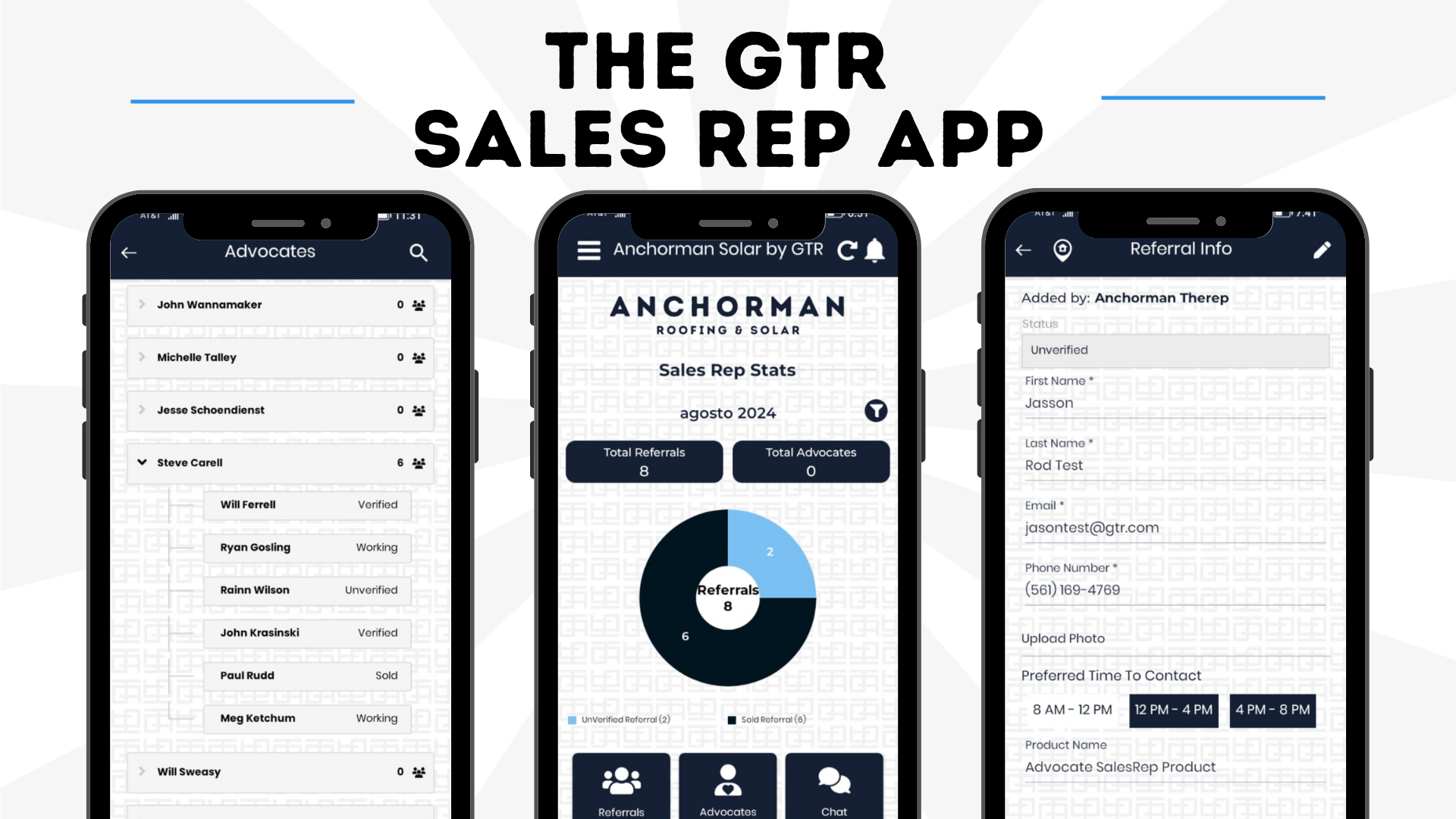
This four-step framework — diagnose, standardize, build the habit, coach the process — is the same one covered live in the full Sell More. Refer More. Grow More: The Sales Rep Playbook webinar, including a live demo of how GTR's Sales Rep App/View supports every pillar above, from capturing the referral in the moment to tracking it through to an appointment.

Watch the full webinar on-demand, free →

How to Train Home Services Sales Reps to Ask for Referrals | GTR

How to Train Home Services Sales Reps to Ask for Referrals | GTR

How to Train Home Services Sales Reps to Ask for Referrals TL; DR Summary: A practical coaching framework for home services leaders — how to...

Read More
The True Cost of Paid Ads vs. Contractor Referrals

The True Cost of Paid Ads vs. Contractor Referrals

The True Cost of Paid Ads vs. Contractor Referrals Most contractors run both channels at once. Paid ads for volume. Referrals for quality. That’s a...

Read More
Why Referral Leads Accelerate Your Sales Cycle and Drive Growth

1 min read

Why Referral Leads Accelerate Your Sales Cycle and Drive Growth

In today’s competitive home services industry, along sales cycleis more than just an inconvenience—it's a threat to your business’s bottom line....

Read More
Why Your Sales Team Needs to Be Plugged-In, Fully Engaged, and Promoting Your Referral Program

1 min read

Why Your Sales Team Needs to Be Plugged-In, Fully Engaged, and Promoting Your Referral Program

As a home services business owner, you know that referrals are golden. They’re often the most cost-effective way to generate new leads and close...

Read More