

Is Your Referral Program Actually Working? The GTR Benchmark Report
 Mikayla Martinsen: September 8, 2026
Article Summary
|
If your roofing business struggles to track leads or capture reviews after a job well done, these operational gaps create friction at a time when you should be scaling. In 2026, the challenge isn’t just generating leads; it’s managing the skyrocketing cost of acquiring them.
With rising cost-per-lead and saturated local markets, the reality is clear: paid leads scale your expenses, but referrals scale your trust. That difference is everything. A neighbor’s recommendation carries a level of implicit credibility that no Google ad can replicate.
Now the real question is whether the ROI of a referral platform outweighs your current acquisition strategy? If you’re still looking for an answer for that, you’ve come to the right place. In this blog, we’ll break down referral software costs for roofing companies to help you choose the best fit for your growth.
Referral program software is a platform designed to systematize what was previously left to chance. Instead of hoping past customers happen to mention your company, you create a repeatable, trackable, and rewarded process.
A modern referral platform helps roofing companies accomplish four core objectives:
The shift from ‘hoping for referrals’ to ‘systemizing referrals’ is exactly why referral program software cost has become a serious line item in contractor marketing budgets.
Roofing is uniquely positioned for referral growth. Jobs are high-ticket, customers feel genuine pride in their investment, and neighbors notice when a roof gets replaced. The opportunity to capture that momentum is enormous if you have the right infrastructure in place.
Understanding the cost of referral program software starts with knowing what you’re actually buying at each price point. The market in 2026 spans a wide range, from lightweight tracking tools to fully automated contractor platforms.
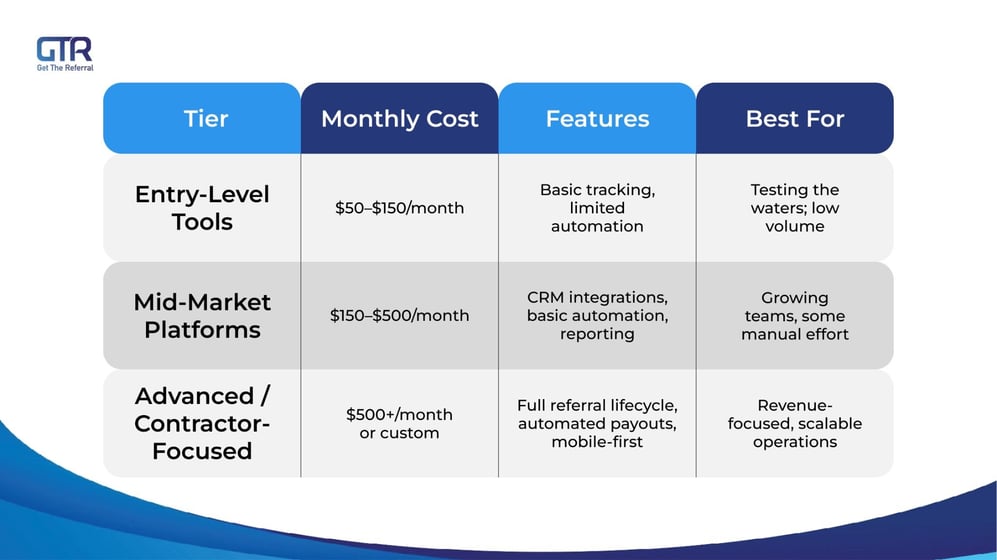
Let’s take a look at the tiers in detail:
At this price point, you’re getting basic referral tracking, mostly a shareable link, a dashboard showing click-throughs, and rudimentary reporting. These tools are built for low-complexity use cases, often e-commerce or SaaS, and require significant manual effort to adapt for field-based sales environments.
They work for early-stage testing, but they are not built for scale. If you’re closing more than five jobs a month, entry-level tools will quickly create operational friction rather than reduce it.
Mid-market platforms introduce CRM integrations, basic automation, and more detailed reporting. This tier is where most growing roofing companies start their search, and for good reason, the feature set covers the fundamentals without enterprise-level pricing.
Most platforms in this range were not designed for field sales. Referral tracking is treated as a marketing function rather than a sales workflow. That means your team still has to manually follow up, and customer engagement often relies on email sequences rather than mobile-first experiences.
At this tier, you’re investing in the full referral lifecycle. Platforms designed specifically for contractors, like GTR, handle everything from initial capture through automated payout, with mobile-first customer engagement and real-time sales visibility.
The pricing model scales with your business volume, so you’re not overpaying during slow seasons, and the platform grows with your operations. This is where referral program software costs stop being an expense and become an investment.
Worth Noting!Referral software pricing typically scales with automation, CRM depth, and how easy it is for field teams and customers to actually use. For enterprise roofing companies operating across multiple regions, standard tools aren’t enough. You need centralized visibility, flexible payouts, and workflows that scale across teams and markets. Some contractor-focused platforms now offer pay-for-performance enterprise models in which pricing aligns with closed jobs rather than fixed fees. This makes it easier to standardize referral programs without high upfront costs. Ready to see how this fits your business? Book a demo and let’s map it to your growth plans. |
Price alone doesn’t tell the full story. The more important question is what you actually get for your referral program software cost, and whether the platform is built for how roofing businesses actually operate.
|
Platform |
Pricing |
Best For |
Key Features |
Limitations |
|
GTR |
Custom (scales with business) |
Home services contractors |
Mobile app, automated referrals, reward payouts, project updates, CRM sync |
Needs onboarding, active usage required |
|
JobNimbus |
$100–$300/mo |
Roofing CRM |
Pipeline management, job & contact tracking, mobile app |
No built‑in referral automation |
|
AccuLynx |
$300+/mo |
Roofing operations |
Estimating, production tracking, scheduling, CRM |
Referrals are managed manually |
|
HubSpot CRM |
Free–$800+/mo |
Marketing teams / small to mid roofers |
CRM, automation, lead capture, marketing tools |
Not contractor-specific, can be costly at scale |
|
Referral Rock |
$175+/mo (starting) |
SMB referral programs |
Referral tracking, integrations, campaign management |
Not built specifically for contractors |
|
ReferralCandy |
$59/mo + fees |
Simple online referral campaigns |
Easy implementation, customer referral focus |
Not suited for roofing workflows or B2B service models |
|
Extole |
Enterprise pricing |
Large brands |
Advanced advocacy systems, automated referrals |
Complex and costly for smaller businesses |
|
Ambassador |
Custom pricing |
Enterprise |
Affiliate + referral tools, partner tracking |
Heavy setup and tech complexity |
|
Tapfiliate |
$89–$149/mo |
SMBs & growing teams |
Referral/affiliate tracking, integrations |
Limited analytics, may scale in price |
|
Contractor-Focused Platforms Change the ROI Equation |
Contractor-Focused Platforms Change the ROI Equation |
Contractor-Focused Platforms Change the ROI Equation |
Contractor-Focused Platforms Change the ROI Equation |
Contractor-Focused Platforms Change the ROI Equation |
Several patterns emerge when you look at the full market:
This is where referral program software costs start to make genuine financial sense, not because the price is lowest, but because the return is highest.
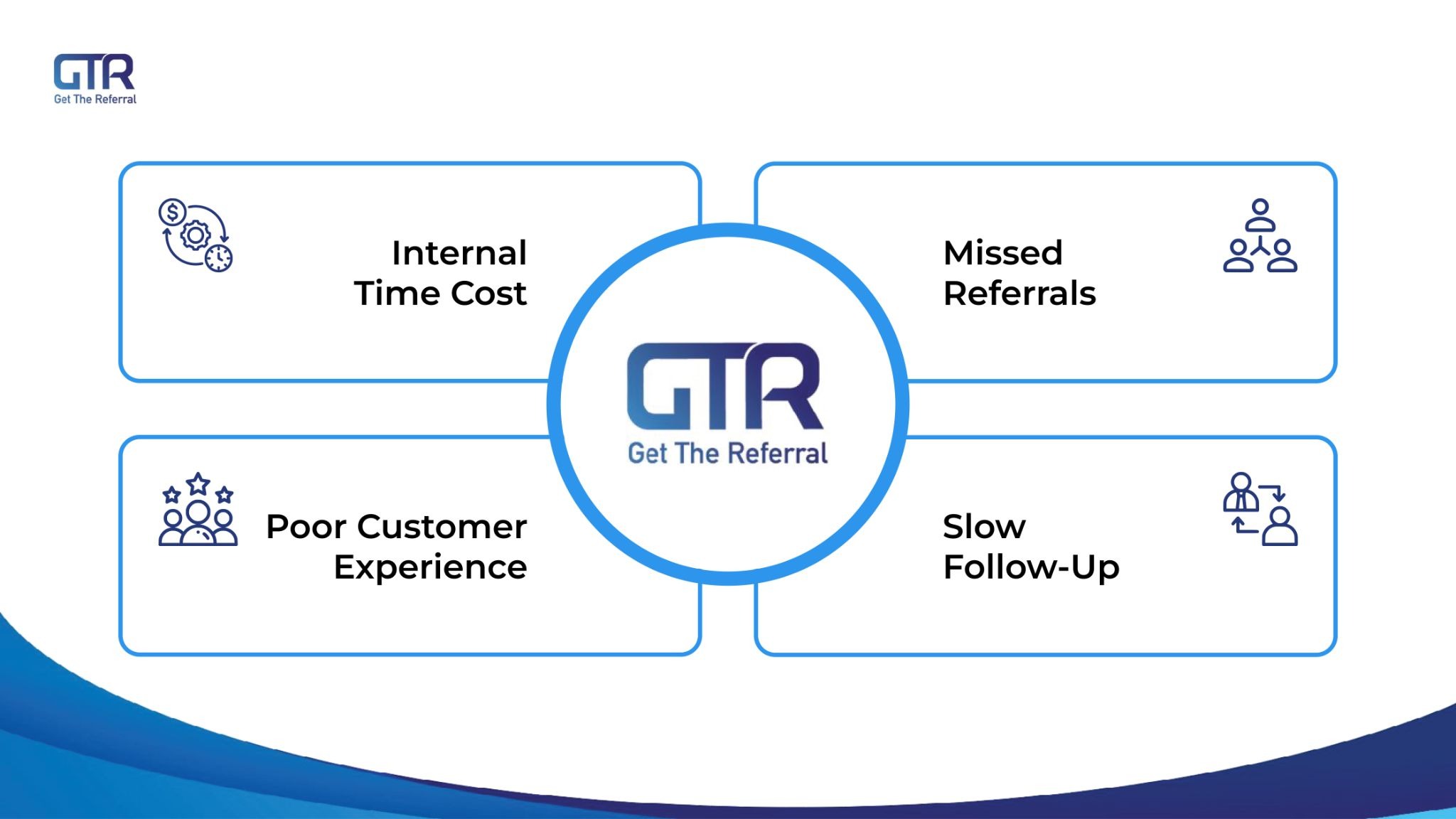
Most conversations about referral program software cost focus on the monthly subscription. But the hidden costs, the ones that don’t appear on an invoice, are often where businesses miscalculate their total investment.
Manual referral tracking consumes hours every week. Asking customers in person, following up by phone, logging responses in a CRM, and verifying that referrals actually converted all of this takes time away from sales and operations. A platform that automates this process isn’t just convenient; it’s a direct reduction in labor cost.
Without a system, referrals happen when a customer happens to think of you, not when you’ve created a deliberate trigger. That gap represents significant lost revenue. If you close 30 jobs a month and 20% of your satisfied customers would refer, given the right prompt, you could be missing five to six potential referrals per month.
Referral leads go cold faster than almost any other type of lead, because they were generated through a personal recommendation that carries time-sensitive momentum. Every day between a referral being made and your team following up reduces your conversion probability. Automated platforms eliminate this gap.
Delayed rewards, or rewards that never arrive, kill referral momentum faster than anything else. If a customer refers to three neighbors but doesn’t receive their payout for weeks, they stop referring. The trust you built during the job has deteriorated due to the experience that follows. Automated payout systems prevent this entirely.
The lowest-priced referral tool often carries the highest total cost once you account for these hidden operational expenses.
Referral program software costs become a strong investment when the conditions for referral success are already in place in your business. The platform amplifies what’s working; it doesn’t create demand from scratch.
Invest in referral software when:
|
Input |
Value |
|
Jobs closed per month |
10 |
|
Referrals generated via the platform |
3 (30% conversion from 10 customers) |
|
Additional revenue |
~$36,000 (3 × $12,000 avg job) |
|
Platform cost |
$500/month |
|
Referral payouts (3 × $300) |
$900/month |
|
Total cost |
$1,400/month |
|
Net additional revenue |
$34,600/month |
|
ROI |
2,471% |
This model is conservative. It doesn’t account for the lifetime value of referred customers (who tend to refer again), or the compounding effect of a growing referral network over 12 to 24 months.
Referral program software is not a set-it-and-forget-it solution, but it’s also not as operationally intensive as most contractors fear. The honest picture looks like this:
Once these conditions are in place, a well-run referral program becomes your most predictable growth channel, one with low CAC, high conversion rates, and leads that arrive with trust already built.
When assessing the cost of referral program software, price should be the last variable you evaluate, not the first. The more important questions are:
A platform that scores well on these dimensions will generate a far stronger return than a cheaper option that creates friction at every stage. The true cost of referral program software is measured by revenue generated per dollar spent, not by subscription fees alone.
Referral program software works best when it’s built for how roofing businesses actually operate: fast-moving sales cycles, high-value jobs, and customers who prefer simple, mobile-first interactions.
Most tools fail because they rely on bulky web portals, manual tracking that doesn’t scale, and unclear reward systems. This friction hits at the peak of customer enthusiasm, causing adoption to plummet and leaving your referral pipeline inconsistent.
GTR takes a different approach.
Whether you’re a growing contractor or an enterprise team operating across multiple markets, GTR is designed to scale with your referral strategy.
Instead of treating referrals like a feature, it builds them into your day-to-day workflow.
With GTR:
Beyond just collecting referrals, you are building a predictable revenue engine. When viewed through this lens, the software cost shifts from an expense to a high-yield investment in lower acquisition costs, superior conversion rates, and sustainable, customer-driven growth.
For roofing companies ready to transform referrals from a “bonus” into a core growth strategy, GTR is engineered for that evolution.
Book a demo and see how referral program software actually performs in a real roofing workflow.
1. What is the average referral program software cost for roofing companies?
Most platforms range from $50 to $500+ per month, depending on features, automation depth, and integrations. Advanced contractor-focused platforms often use custom pricing aligned with business size and monthly referral volume, which makes the per-referral cost more predictable as you scale.
2. Is referral program software cheaper than paid leads?
Yes, in most scenarios. While you pay for the platform subscription and referral rewards, the total customer acquisition cost for a referred job is consistently 60 to 75% lower than leads from paid channels like Google LSA or Angi. Referral leads also tend to convert at higher rates and carry higher lifetime value.
3. What additional costs should I budget for beyond the monthly subscription?
The main additional costs are referral payouts (typically $200 to $500 per closed job, depending on your structure), onboarding time for your team, and any required CRM integration work. These costs are usually offset within the first one to two months of a well-run program.
4. How quickly can I expect to see ROI from referral software?
Most roofing companies with an existing base of satisfied customers and consistent job flow see measurable results within the first four to eight weeks. The fundamental driver is having a defined process for when and how referrals are requested; the platform handles the rest.
5. Do I need referral software if I’m already getting organic referrals?
Especially if you’re already receiving referrals organically. Without a system, those referrals are inconsistent, untracked, and unmeasurable. Software gives you the infrastructure to scale what’s already working, attribute revenue to specific advocates, and build a referral channel that performs regardless of which team member is on a job.
 Mikayla Martinsen: August 26, 2026
How Referral Software Improves Contractor Lead Flow
 Mikayla Martinsen: August 24, 2026
How to Train Home Services Sales Reps to Ask for Referrals TL; DR Summary: A practical coaching framework for home services leaders — how to...
1 min read
Mikayla Martinsen : August 17, 2026
The True Cost of Paid Ads vs. Contractor Referrals Most contractors run both channels at once. Paid ads for volume. Referrals for quality. That’s a...

1 min read
A regular influx of qualified leads is an essential part of success for most companies. You can spend a significant amount of time and money on...
1 min read
Mikayla Martinsen : July 1, 2024
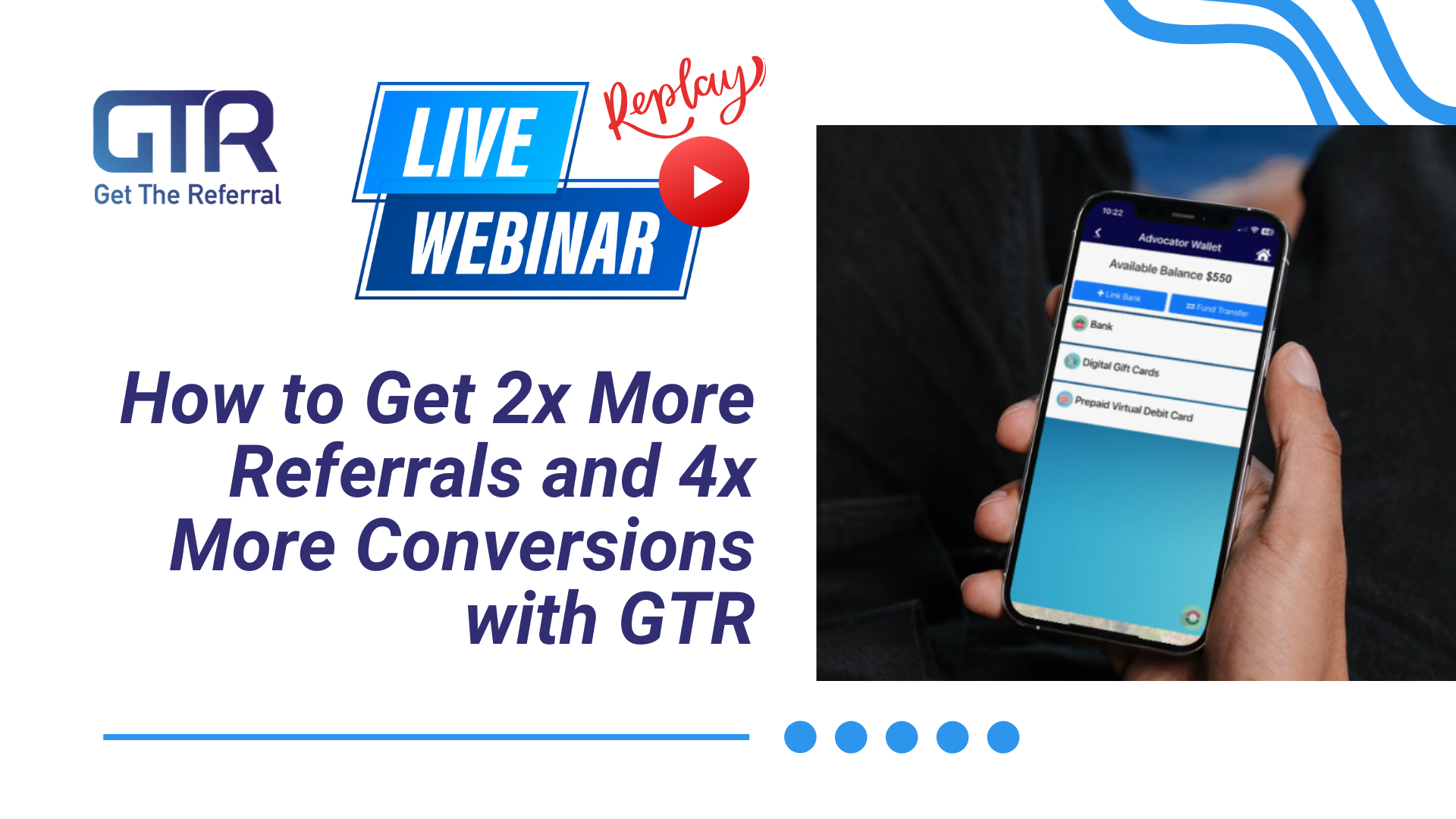
We recently hosted an insightful webinar exploring how the GTR Wallet feature can revolutionize referral programs for home services companies. Here...