

The Leap From 'Yes' to Signed, Without Losing the Trust You Earned
 Mikayla Martinsen: September 21, 2026
If you run a roofing, remodeling, or solar company, you know referrals close faster and cost less than paid leads. The challenge is making referrals consistent. Most home services businesses leave this to chance—hoping customers remember to mention them to neighbors. Get The Referral gives you a way to automate customer referrals by building a system that handles invites, tracking, and rewards for you.
This guide walks you through everything: what referral automation means, how instant reward payouts work, how to measure ROI, and the steps to build an automated referral workflow. By the end, you'll have a clear path to generating more leads without increasing your ad spend.

Referral automation is the process of using software to handle every step of your referral program. Instead of manually tracking who referred whom on a spreadsheet, the software captures each referral, monitors its progress through your sales pipeline, and triggers rewards when deals close.
For a roofing contractor, this might look like a homeowner completing a roof replacement, receiving an invite to join your referral program through a branded mobile app, and then sending their own referral link to a neighbor. When that neighbor signs a contract, both parties receive their rewards automatically.
The key difference between automated and manual programs is consistency. Manual programs rely on memory and spreadsheet updates. Automated programs run in the background, capturing referrals as they happen and ensuring no one falls through the cracks.
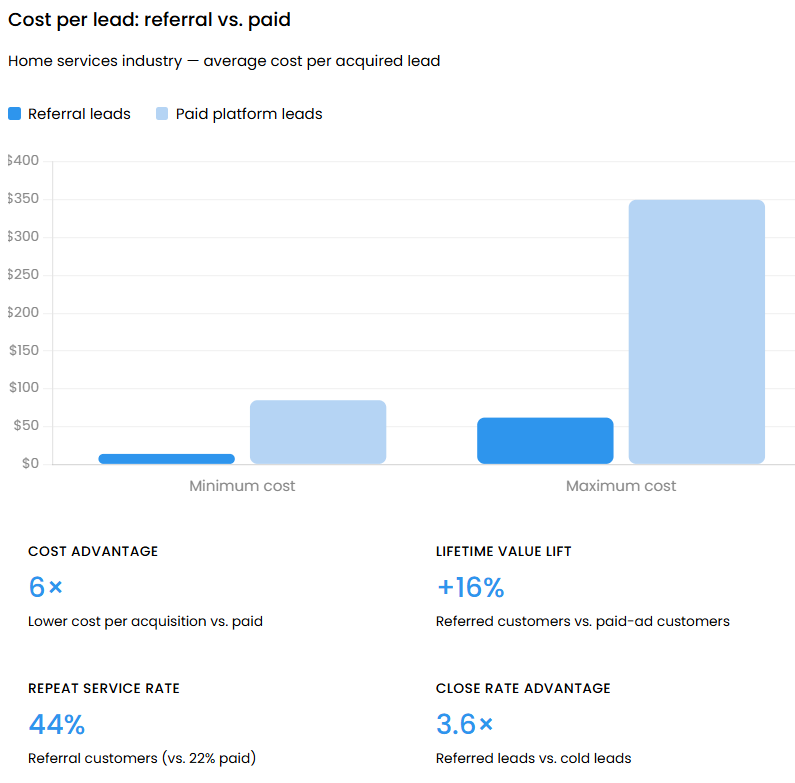
The economics of referrals versus paid advertising are stark. According to HomeAdvisor data, the average cost per lead from paid platforms ranges from $85 to $350, depending on your trade. Referral leads cost an average of $14 to $62. That's a 6x cost-per-acquisition advantage.
Beyond cost, referred customers behave differently. According to Housecall Pro's revenue attribution analysis, referred customers have a 16% higher lifetime value ($3,800 vs. $3,270) and a 44% repeat service rate compared to 22% for customers acquired through paid advertising.
Most contractors already get some referrals. The problem is inconsistency. Without a system, you're hoping customers remember to mention you. With automation, you prompt them at the right moment, make sharing easy, and reward them immediately—which encourages them to refer again.
Untracked referrals cost the average home services business $2,200 to $4,800 per month in unpaid incentives, according to ServiceTitan operational audit data. When advocates don't receive their rewards, they stop referring. This creates a downward spiral where your best lead source dries up.
Automated tracking recovers 94% of attribution that would otherwise be lost. This means more advocates receive their rewards, stay engaged, and continue sending new customers your way.
Instant rewards solve one of the biggest friction points in referral programs: delayed gratification. When an advocate has to wait weeks for a check in the mail, their excitement fades. Instant digital payouts keep the momentum going.
Modern referral platforms offer multiple reward options. Cash transfers go directly to bank accounts. Prepaid Visa cards can be spent anywhere. Digital gift cards arrive in seconds. The advocate chooses their preferred method, which increases satisfaction and participation rates.
GTR simplifies instant rewards through the GTR Wallet, which is powered by Xtrm. When a deal closes, your business triggers the payout, and the advocate receives their reward immediately. They can transfer funds to their bank, spend via prepaid Visa, or redeem digital gift cards—all from a single interface.
The platform also handles tax compliance, including 1099-K support. This removes the administrative burden of tracking payouts and generating tax documents for advocates who earn above reporting thresholds.
A well-designed automated referral workflow has five stages. Each stage happens automatically once you set up your program.
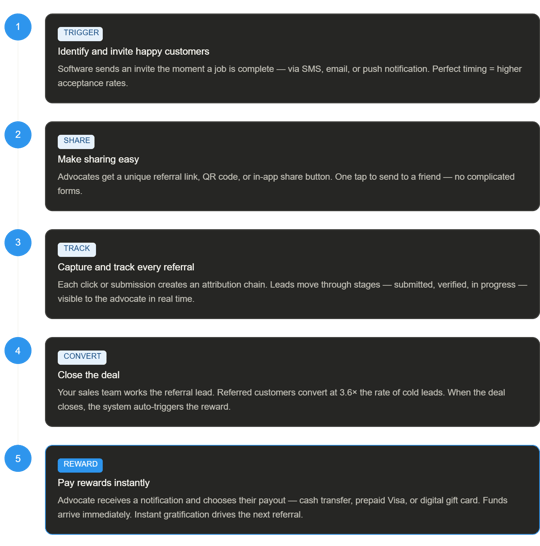
Timing matters. The best moment to ask for a referral is right after you've delivered a positive experience. For a roofing company, that's when the final walkthrough is complete, and the customer is satisfied. Your software should trigger an invite at this moment.
The invite can arrive via email, SMS, or push notification through your branded mobile app. The message explains the program and makes it easy for the customer to become an advocate with a single tap.
Advocates need simple tools to share your business. A unique referral link that they can text, email, or post on social media works well. QR codes are useful for in-person sharing. Some platforms also support direct referral submission through a mobile app.
The easier you make this step, the more referrals you'll receive. Any friction, like complicated sign-up forms or confusing instructions, reduces participation.
When someone clicks an advocate's link or submits their information, the software captures that data. This creates an attribution chain: who referred whom, when it happened, and where it came from.
The referral then moves through your pipeline. You can set stages like "submitted," "verified," "in progress," and "sold," depending on your process. At each stage, the advocate can see progress in your app, which keeps them engaged.
Your sales team works the referral lead like any other opportunity. The difference is that referred leads typically close faster. According to Wharton School of Business research, referred customers convert at 3.6x the rate of cold leads.
When the deal closes, the system automatically triggers the reward. No manual approval needed unless you configure it that way.
The advocate receives a notification that their referral has sold (i.e., a closed won deal) and their reward is ready. They choose their payout method and receive funds immediately. This instant gratification reinforces the behavior and encourages them to refer again.
ROI measurement is where many referral programs fall short. Without clear data, you can't tell whether your program is working or how to improve it.
Cost per referral lead: Divide your total program costs (software plus rewards) by the number of referral leads generated. For most home services businesses, this should be under $100 per lead.
Referral close rate: Track what percentage of referral leads convert to paying customers. Industry benchmarks show referral leads close at 30% higher rates than paid leads.
Revenue attributed to referrals: Sum the total revenue from all jobs that originated as referrals. This gives you a clear picture of how much your program contributes to the business.
Advocate participation rate: Measure what percentage of invited customers become active advocates. Higher participation rates indicate a healthy program with appealing incentives.
Let's say you spend $1,500 per month on your referral platform and rewards. In that month, you receive 25 referral leads and close 8 jobs with an average value of $12,000. Your calculation looks like this:
Total revenue from referrals: 8 × $12,000 = $96,000
Total program cost: $1,500
ROI ratio: $96,000 ÷ $1,500 = 64:1 (64X)
This is an oversimplified example, but it illustrates why referral programs often outperform every other acquisition channel. Even at more conservative numbers—say 4 closed jobs at $8,000 each—you're still looking at a 21:1 return (21X).
For more info on referral metrics, check out this article: 10 Referral Metrics Every Home Services Pro Should Track.
Not all referral software is created equal. For home services businesses, you need specific capabilities that match how your industry operates.
Your customers don't sit at desks. They're busy homeowners who interact with their phones. Your referral platform needs a mobile app that makes it easy for them to refer on the go, track their referrals, and collect rewards.
Sales reps also need mobile access. They should be able to invite new advocates during service appointments and check referral status from the field.
Your referral data should flow into your existing systems. Look for platforms that integrate with popular CRMs so referral leads automatically appear alongside your other opportunities. This eliminates double data entry and ensures nothing gets lost.
Manual reward processing creates delays and errors. Choose a platform that handles payouts automatically, offers multiple reward types (cash, gift cards, prepaid debit), and manages tax compliance for you.
You need a dashboard that shows referral volume, conversion rates, advocate activity, and ROI in real time. Waiting for monthly reports means missing opportunities to optimize your program.
Get The Referral was built specifically for home services businesses—roofing, solar, remodeling, HVAC, and more. The platform includes five connected components that handle every aspect of your referral program.
-v3-1-1.png?width=500&height=500&name=GTR-ReferralHub-(500%20x%201280%20px)-v3-1-1.png)
Your customers get a branded mobile app where they can track their project progress, submit referrals, and see their rewards. The app keeps them engaged with your brand and makes referring as easy as sharing a link.
Your sales team gets their own app to invite advocates, track referral leads, and monitor performance. This puts referral generation into the hands of the people who interact with customers every day.
Referral Boost helps you capture referrals from past customers for a quick launch, and for those who prefer not to download an app. Web-based referral forms, email invites, and SMS links ensure you don't miss opportunities from less tech-savvy customers.
The GTR Wallet handles all reward payouts. Advocates choose how they want to receive their rewards, and the system processes payments instantly. Built-in tax compliance means you don't have to worry about 1099 reporting.
The Admin Dashboard gives you complete visibility into your referral program. Track every referral from submission to close, manage rewards, monitor advocate activity, and measure ROI—all from one centralized hub.
Manual referral tracking—using spreadsheets, sticky notes, or memory—has significant limitations. Understanding these helps clarify why automation is worth the investment.
Manual systems lose 40-60% of referral credits, according to Housecall Pro operational audits. Advocates don't get their rewards, they stop referring, and your program loses momentum. Automated systems capture referrals as they happen, ensuring proper attribution.
With manual tracking, referral leads often sit uncontacted for days. Automated systems can trigger instant notifications to your sales team, ensuring fast follow-up. Given that lead response time is critical in home services—the first contractor to respond often wins the job—this speed advantage is significant.
Manual systems break down as your business grows. One person can track 20 referrals a month on a spreadsheet, but what happens at 200? Automated systems scale with your business, handling high referral volumes without additional labor.
Even with great software, certain mistakes can undermine your referral program. Here's what to watch out for.
A referral program only works if people know about it. Don't treat it as a "set it and forget it" initiative. Promote it continuously through email, in-app notifications, social media, and in-person conversations during service visits.
Confusing reward structures discourage participation. Keep it simple: "Refer a friend, get $X when they become a customer." You can add tiers or bonuses later, but start with something easy to understand.
The person receiving the referral should get a positive first impression. Make sure the friend's onboarding is smooth, the offer is clear, and they understand what they're getting. When both the advocate and the friend have good experiences, referrals multiply.
Fast follow-up is essential. If a referral lead contacts you and doesn't hear back for days, they'll move on to a competitor. Set up your system to notify sales immediately when new referrals come in.

Results vary based on your starting point, but most businesses see a measurable impact quickly.
During the first month, you're onboarding advocates and building momentum. Focus on inviting your existing customer base and training your sales team to promote the program. Most businesses see their first automated referrals close during this period.
By the second and third months, your advocate base has grown. Automated reminders are working to re-engage advocates who haven't referred recently. You'll have enough data to start measuring ROI and identifying your top referrers.
Referral programs improve over time. Analyze which advocates are most active, what incentives drive the most referrals, and where leads are getting stuck in your pipeline. Use this data to refine your approach and continuously improve results.
The goal of referral automation isn't just to generate a few extra leads. It's to build a predictable, scalable acquisition channel that grows with your business.
Top-performing contractors attribute 35% or more of their revenue to referral-sourced customers. Getting there requires treating your referral program as seriously as you treat paid advertising or SEO. That means investing in the right tools, promoting the program consistently, and optimizing based on data.
With automation handling the mechanics, you can focus on what you do well—delivering excellent service that makes customers want to refer you in the first place.
Referral automation platforms for home services businesses typically range from $50 to $500+ per month, depending on features and scale. Factor in reward payouts as an additional cost. When you calculate ROI, most businesses find the investment pays for itself many times over through reduced acquisition costs and increased referral volume.
Cash rewards are the most popular choice because they're universally appealing. Gift cards to major retailers also perform well. Get The Referral supports multiple reward types—cash transfers, prepaid Visa cards, and digital gift cards—so advocates can choose what works for them. Two-sided incentives, where both the advocate and the referred friend receive something, generate 2.3x more referrals than one-sided programs.
Yes. Get The Referral includes Referral Boost for customers who prefer not to download an app. Web-based referral forms, email invites, and SMS links ensure every customer can participate. The key is offering multiple ways to refer so you capture opportunities regardless of how comfortable your customers are with technology.
Modern referral platforms integrate with popular CRMs through APIs, webhooks, and native connectors. Get The Referral offers integrations with major CRMs as well as field tools like ContractorFlow and CompanyCam. This ensures referral leads flow directly into your existing sales workflow without manual data entry.
Referral software focuses on turning your existing customers into advocates who share your business with friends and family. Affiliate tracking is typically used for professional marketers or partners who drive traffic in exchange for commissions. For home services businesses, referral software is usually the better fit because it builds on the trust your customers already have in your work.
Make it easy and rewarding. Get The Referral includes a Sales Rep App that lets reps invite advocates with a few taps and track their referral contributions. When reps see that their referrals are leading to closed deals—and they can track that progress in real time—they're more motivated to participate. Some businesses also tie referral generation to sales incentives to encourage adoption.
 Mikayla Martinsen: September 16, 2026
Contractor Lead Costs: 7 Lead Sources Compared
 Mikayla Martinsen: September 15, 2026
Contractor Lead Quality: How to Get More Leads That Actually Close More leads sound like the answer to every contractor's growth problem.
 Mikayla Martinsen : July 8, 2026
Learn how referral software helps contractors cut lead costs through automated tracking, instant rewards, and higher close rates with GTR.
 Mikayla Martinsen : August 5, 2026
A simple guide to setting up referral rewards for contractors — reward types, job-size tiers, fast payouts, and basic rules to know.
 Mikayla Martinsen : April 20, 2026
Discover the best referral software for contractors in 2026. We've evaluated top platforms to help you automate referrals and boost your ROI...