

 Darren Gomez

The Leap From 'Yes' to Signed, Without Losing the Trust You Earned
 Mikayla Martinsen: September 21, 2026
|
|
Referral analytics are the metrics businesses use to measure how effectively customers, sales representatives, and referral leads move through a referral program.
For home improvement and home services companies, these analytics help answer important questions:
Get The Referral (GTR) helps SMB and enterprise home services organizations answer these questions by connecting participation, referral activity, lead progress, sales, and revenue into one measurable referral journey.
SMB clients can manage referrals and update lead statuses directly through the GTR Dashboard. A CRM integration is not required to operate, manage, or measure a successful GTR referral program.
Referral analytics turn word-of-mouth marketing into a measurable customer acquisition channel for home services companies.
Without accurate reporting, a home improvement business may know that referrals are being generated but have limited visibility into why the program is succeeding or where it is losing momentum. Analytics show what happens at every stage—from the first customer invitation through the final sale.
This allows companies to make decisions based on actual program performance instead of assumptions.
For example, a roofing, solar, or remodeling company may have an excellent referral close rate but a low number of referrals. The problem may not be lead quality. It may be that too few sales representatives are introducing the program to their customers.
Referral analytics help identify that difference and show the business where to focus its efforts.
The most important referral program metrics measure participation, advocate engagement, lead progression, revenue, and return on investment.
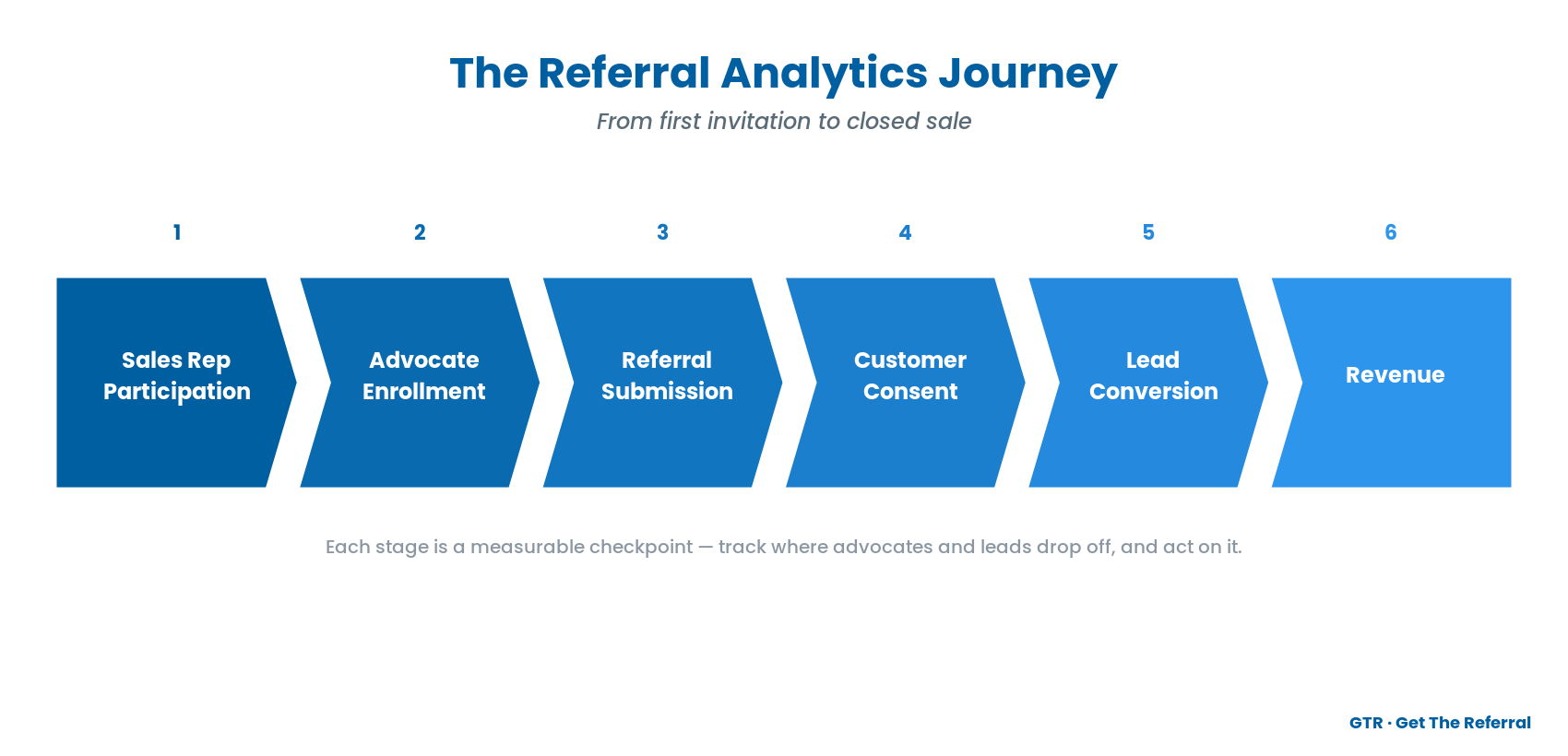
The referral analytics journey: each stage below maps to one of the metrics in this section.
Sales representative utilization measures the percentage of eligible sales representatives actively enrolling customers as advocates.
Low utilization may indicate a need for additional training, stronger management accountability, or a more consistent process for introducing the referral program.
The advocate enrollment rate measures how many invited customers join or access the referral program.
This helps businesses evaluate whether customers understand the program’s value and whether the enrollment process is convenient.
The advocate referral rate measures the percentage of enrolled advocates who submit at least one referral.
A high enrollment rate with a low referral rate may indicate that the company needs better advocate communication, reminders, campaigns, or incentives.
The referral consent rate measures the percentage of referred consumers who provide permission to be contacted.
Consent is an important part of moving a referral from an advocate submission into an actionable lead for the sales team.
The referral conversion rate measures the percentage of referral leads that reach important sales milestones, such as working, verified, sold, or lost.
Tracking these stages helps companies understand both referral quality and sales-team follow-through.

Referral revenue is the total sales value attributed to referral leads.
This metric connects referral activity to financial performance and helps leadership understand the program’s contribution to company growth.
Referral program ROI compares the financial value generated by referral sales with the cost of operating the program. Use the GTR ROI Calculator to estimate your own program's revenue impact in about 90 seconds.
A basic referral program ROI formula is:
Referral Program ROI = (Referral Profit − Program Cost) ÷ Program Cost × 100
Companies can also evaluate their break-even point by calculating how many referral sales are needed to cover the program’s cost.
Small and midsized home services businesses should use referral analytics to identify the specific actions that will generate more advocates, referrals, sales, and revenue.
For many home improvement SMBs, the primary question is:
Is our referral program producing enough business to justify our investment?
Total revenue, however, does not tell the complete story. An SMB should also measure the behaviors that lead to that revenue.
Referral analytics can help an SMB:
A home improvement SMB may discover that its referral leads close at a strong rate, but only a small percentage of its sales representatives actively use the program. That insight gives management a clear action: improve representative participation before investing in additional lead generation.
Yes. SMB clients can manage their referral program directly through the GTR Dashboard without integrating GTR with a CRM.
Authorized users can use the dashboard to:
This allows an SMB to launch, manage, and measure a structured referral program regardless of its existing technology.
A CRM integration is optional. It may be helpful for companies that want to automate the exchange of referral and lead-status data, but it is not required to use GTR successfully.
Enterprise home improvement companies should use referral analytics to compare performance across brands, regions, locations, teams, and sales representatives.
Company-wide averages can hide significant differences. One location may have strong advocate enrollment but low referral activity. Another may generate many referrals but struggle to contact or convert them.
Enterprise referral analytics provide consolidated reporting while preserving the local-level visibility needed to manage performance.
Leadership can use the data to compare:
This visibility becomes especially valuable as home improvement companies expand through new locations, additional brands, or acquisitions.
Businesses managing a growing portfolio of home improvement operating companies may inherit different sales processes, CRM systems, reward structures, and levels of referral program maturity. A consistent set of referral KPIs allows leadership to compare performance without requiring every brand to operate in exactly the same way.
If one brand or region consistently produces more referrals per advocate, leadership can investigate why. The difference may be stronger sales training, better customer communication, more consistent follow-up, or greater local management accountability.
These insights help organizations identify successful practices that can be introduced across additional teams, locations, or portfolio companies. Referral analytics turn local success into a repeatable operating model.
A multi-brand referral strategy should provide organization-wide visibility without eliminating the identity or operating independence of each brand.
Leadership may need consolidated performance data, while individual brands, regions, and locations need access to their own results.
This gives each level of the organization actionable information:
This structure can support organic growth across an expanding organization while allowing individual brands to maintain their established customer relationships and market identities.
Following an acquisition, companies often focus on systems, reporting, operational alignment, and opportunities for organic growth.
Every acquired home improvement brand also brings an established customer base. A structured referral program gives the organization a way to engage those customers, generate new opportunities, and measure the resulting revenue.
Referral analytics can help leadership evaluate:
This makes referrals a measurable part of a post-acquisition growth strategy without requiring every operating company to use the same CRM or follow an identical workflow.
SMB referral analytics generally focus on individual participation, lead management, break-even performance, and immediate ROI.
Enterprise analytics require broader reporting that can compare multiple teams, locations, brands, or operating companies.
The organizational scale may be different, but the objective remains the same: identify which activities produce referrals and use those insights to improve performance.
No. A CRM integration is not required to use GTR, manage referrals, update lead statuses, or measure referral program performance.
GTR can operate as a standalone referral management platform. Businesses can manage referrals directly through the GTR Dashboard.
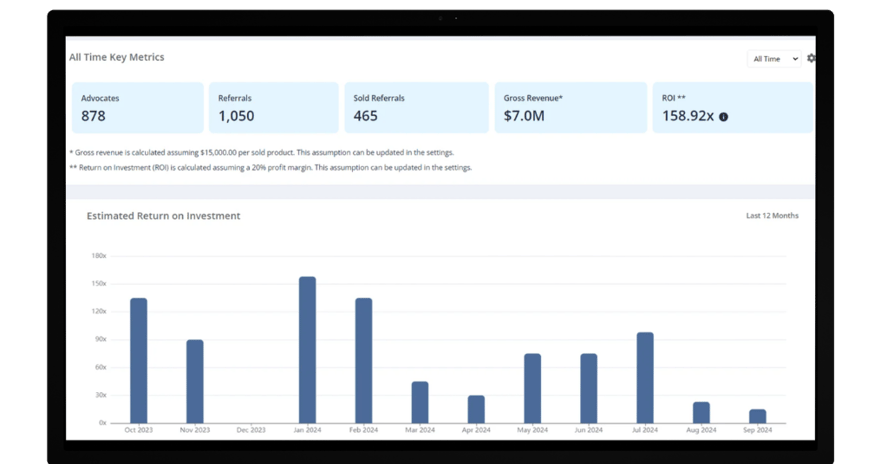
The GTR Dashboard allows authorized users to:
This is especially valuable for SMB clients that want a straightforward way to manage referrals without adding technical complexity.
CRM integration may be helpful when a company wants to automate workflows between GTR and its existing systems. GTR offers CRM integrations with platforms including Salesforce, HubSpot, and Leap.
Depending on the CRM’s capabilities, an integration may:
Enterprise organizations may benefit from integration because of their size, referral volume, or operational complexity. However, integration is an automation option—not a requirement for using GTR or managing referrals successfully.
Organizations operating multiple brands do not necessarily need every company to use the same CRM. Each brand’s workflow can be evaluated based on its existing systems and operational requirements.
Referral analytics improve program performance by showing businesses where advocates and leads stop progressing through the referral journey.
The data may reveal that a company should:
This creates a continuous improvement cycle:
Measure performance. Identify the gap. Take action. Evaluate the result.
GTR provides referral program analytics that help businesses monitor advocate growth, referral activity, lead progression, sales, revenue, and team participation.
For SMBs, GTR provides actionable visibility into the representatives and customer behaviors driving results. Referrals and lead statuses can be managed directly through the GTR Dashboard without requiring a CRM integration.
For enterprise organizations, GTR helps leadership evaluate performance across a larger organizational structure, including multiple brands, regions, branches, and teams. Optional integrations may help automate data movement and support more complex workflows.
For growing multi-brand home improvement organizations, GTR provides a consistent referral framework that can help leadership compare performance, establish shared KPIs, and identify successful practices that can be scaled across the business.
This allows referral programs to be managed as structured, measurable growth channels instead of informal customer initiatives.
The strongest referral programs are supported by clear ownership, consistent processes, accurate lead-status data, and measurable goals.
Referral analytics give businesses the visibility to understand what drives results—from the first advocate invitation to the final sale.
For growing home improvement organizations, every new brand or acquisition also adds an established customer base. A consistent referral strategy can turn those customer relationships into a measurable organic growth channel.
When companies can identify the behaviors generating referrals and revenue, they can improve those behaviors, scale successful practices, and build a more predictable source of growth.

Schedule a walkthrough of the GTR Dashboard and see how referral analytics can drive measurable growth for your home improvement or home service brand.
Curious what results look like in practice? See what home improvement teams are saying.
Referral analytics are the measurements used to track sales representative participation, advocate activity, referral volume, consent, lead conversion, sales, revenue, and ROI within a referral program.
No. Businesses can manage referrals and update lead statuses directly in the GTR Dashboard. CRM integration is optional and may be used to automate data exchange or support more complex workflows.
Yes. SMB clients can view referrals, manage leads, update statuses, record outcomes, and monitor program performance directly through the GTR Dashboard.
Yes. Referral analytics can provide consolidated visibility across multiple brands, locations, or portfolio companies while preserving brand-level performance data. This allows leadership to establish common KPIs, compare results, and identify successful practices that can be scaled across the organization.
No. GTR does not require every brand or operating company to use the same CRM. Referrals can be managed through the GTR Dashboard, while optional integrations can support brands that want to automate lead and status data based on their individual systems and operational needs.
Referral analytics help leadership evaluate customer advocacy, sales representative participation, referral volume, conversion, and revenue across newly acquired brands. This can reveal organic growth opportunities and successful practices that may be scaled across the broader organization.
There is no single metric that tells the entire story. Revenue and ROI measure financial results, while sales representative utilization, advocate referral rate, consent rate, and close rate explain how those results were produced.
Referral program success is measured by comparing participation, referral activity, conversion, revenue, profit, and program cost. Businesses should measure both final results and the activities that lead to them.
Subtract the referral program's cost from the profit generated by referral sales, divide by the program cost, and multiply by 100. See this step-by-step ROI guide for a full walkthrough.
ROI = (Referral Profit − Program Cost) ÷ Program Cost × 100
Active referral programs should generally be reviewed at least monthly. Sales participation and referral follow-up may need weekly review, especially during onboarding, training, or a new program launch.
Referral tracking records individual activities, such as an advocate joining, a referral being submitted, or a lead becoming a sale. Referral analytics combine those activities to reveal performance trends, conversion rates, revenue, and opportunities for improvement.
Yes. Enterprise referral reporting can be structured to compare performance across locations, regions, teams, brands, or other business units, provided the necessary organizational data is available.
Lead-status data shows what happened after a referral was submitted. It allows businesses to measure lead progression, sales conversion, revenue, and program ROI.
Yes. Participation reporting identifies which representatives consistently enroll advocates and which may need additional coaching, training, or management support.
Referral analytics are especially valuable for home services businesses—including roofing, solar, windows, siding, gutters, remodeling, insulation, and bath renovation—where customer trust and word-of-mouth strongly influence purchasing decisions.
 Mikayla Martinsen: September 16, 2026
Contractor Lead Costs: 7 Lead Sources Compared
 Mikayla Martinsen: September 15, 2026
Contractor Lead Quality: How to Get More Leads That Actually Close More leads sound like the answer to every contractor's growth problem.
 Mikayla Martinsen : May 25, 2026
Learn 10 referral analytics metrics that prove ROI for home services and roofing. Track what matters with GetTheReferral's automated reporting.
 Mikayla Martinsen : April 20, 2026
Discover the best referral software for contractors in 2026. We've evaluated top platforms to help you automate referrals and boost your ROI...
 Jameila Bito-On : June 23, 2025
Learn how to run effective referral contests for home services businesses to boost leads, lower acquisition costs, and increase ROI. Learn more...