
How Referral Programs Grow Over Time
 Mikayla Martinsen: October 12, 2026
You work hard to win every customer. You invest in marketing, follow up fast, earn the homeowner's trust, and deliver a great project. Then the job closes, and too often, the relationship stops there.
A referral program changes what happens next. It gives happy customers an easy way to recommend you, so the value of each customer you win can extend well beyond the first completed job. It turns the path from inquiry to install into something bigger: inquiry to install… and beyond.
But a referral program doesn't hit full strength in its first 60 days. Every customer you enroll as an advocate stays in your network. Every sales rep who builds the habit of asking keeps asking. The program you have in Year 3 is built on everything you did in Years 1 and 2.
So the real question isn't "Did it work this quarter?" It's "What should this program look like at each stage, and are we on track?"
This guide uses data from the 2026 GTR Referral Benchmark Report to show what happens after launch. You'll see what to focus on in Year 1, what starts to compound in Year 2, and how to get the most ROI out of an established program in Year 3 and beyond.
Already know how to launch? This post picks up after launch day. If you're still setting up, start with How to Launch a Referral Program in 30 Days or How to Build a Referral Program for Contractors.
A contractor referral program can start paying for itself within a few months. But it usually takes two to three years to become a major growth channel.
GTR customer data shows that although referrals often begin to flow right away, the typical time to first ROI ranges from 1–3 months for enterprise teams to 6–12 months for small teams just getting started. After that, results build.
Across 209 home service companies in GTR's dataset, median monthly referrals roughly double between a company's first year on the platform and its fifth. And GTR's highest-ROI customers reached their peak results after more than three years of building their programs — not in the first few months.
The reason is simple: a referral program isn't a one-time campaign. It builds an advocate network from the customers you've already won, and that network keeps growing.
Every customer you win is a growth milestone. With a referral program, it can also be the start of your next opportunity. Over time, that adds up to a growth flywheel:
Acquire → Convert → Deliver → Advocate → Refer → Acquire again
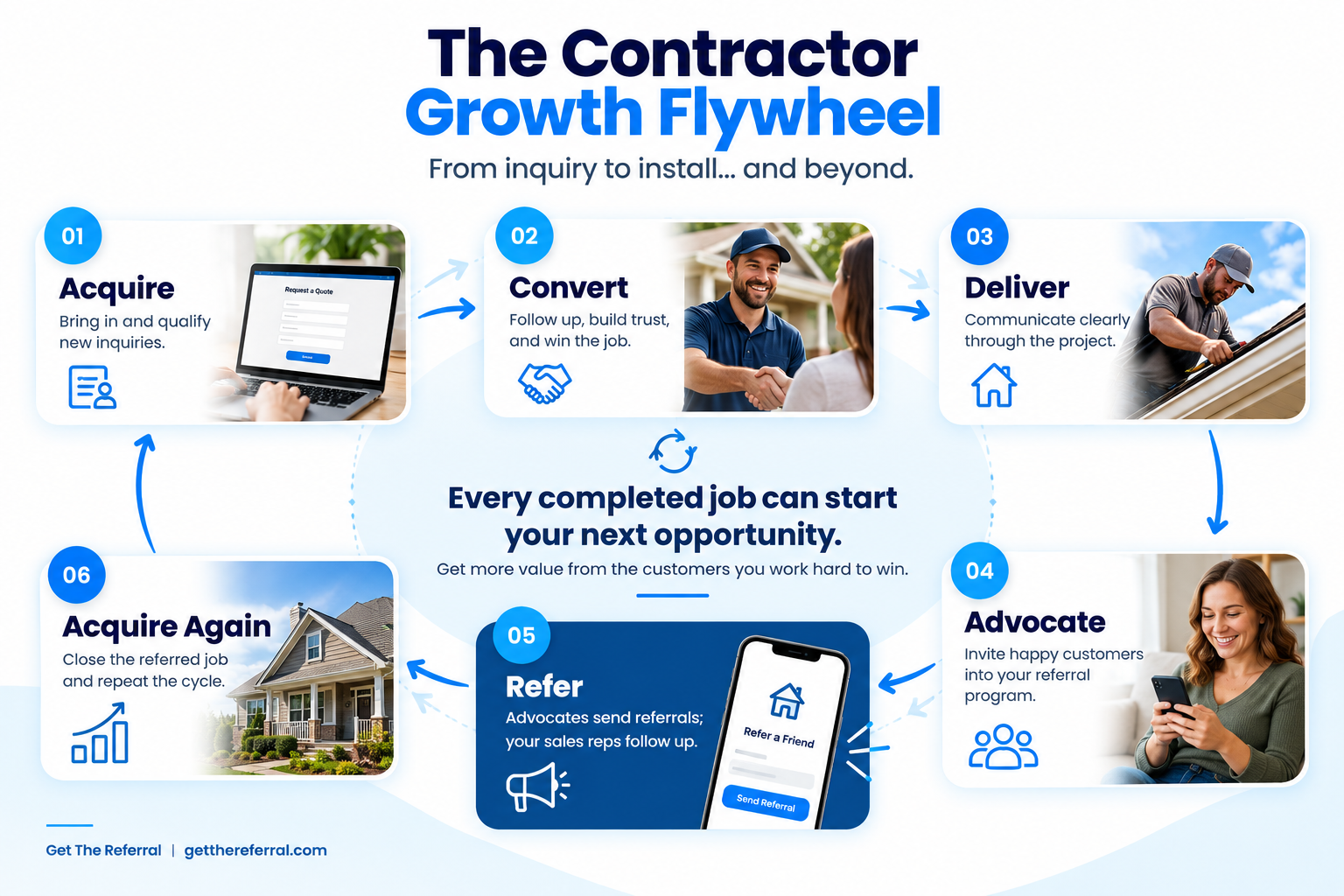
You bring in new customers through your marketing. Your sales team wins the job. Your crew delivers a great project. Happy customers become advocates. Advocates send referrals. Your sales reps close those referrals, and the cycle starts again.
Three things make that flywheel spin faster each year:
Here's what that looks like in GTR's data:
|
What GTR's Data Shows |
The Number |
|---|---|
|
Median monthly referrals, Year 1 vs. Year 5 |
Roughly double |
|
Average referral conversion rate (verified customers) |
37.5% |
|
Time on platform for the 518X ROI company |
3.33 years |
Source: 2026 GTR Referral Benchmark Report. Volume data from GTR Lens (209 active home service companies, May 2026). Conversion data from GTR's verified customer cohort; this is referral-lead conversion, not a company's overall close rate. ROI measured over 6 months (12/1/2025–5/31/2026) as profit from referral-driven jobs ÷ GTR subscription cost; advocate rewards and operating costs not included. Individual results vary.
The goal in Year 1 isn't maximum referral revenue. It's building the system that will produce referral revenue for years.
Year 1 is about adoption. You're teaching sales reps a new habit and showing customers that your company makes referring easy and rewarding. Most of what you build this year pays off later.
Don't panic if early referral volume looks small. In Year 1, a growing advocate count is a better sign than a big referral count. Advocates you enroll this year are the ones who send referrals next year.
Most teams also see their first ROI in Year 1. Based on GTR customer data, typical time to first ROI is:
|
Company Size |
Sales Rep Count |
Typical Time to First ROI |
|---|---|---|
|
Small — just getting started |
2 to 10 sales reps |
6 to 12 months |
|
Mid-size — growing team |
10 to 50 sales reps |
3 to 9 months |
|
Established — multiple crews |
50 to 100 sales reps |
1 to 6 months |
|
Enterprise — regional/national |
100+ sales reps |
1 to 3 months |
Source: 2026 GTR Referral Benchmark Report. Results vary based on industry, job value, sales rep adoption, and market.
Bigger teams complete more jobs, so they enroll advocates faster and reach ROI sooner. Smaller teams get there too — it just takes longer to build the network.
The goal in Year 2 is turning a working habit into a growing pipeline.
This is when the Year 1 work starts to really show. Your advocate network is bigger. Some advocates are referring for the second or third time. Referrals start showing up without your sales reps having to ask for each one.
Referral volume in Year 2 should be climbing month over month — not because you're asking harder, but because more advocates are in the network. If volume is flat, look at enrollment first. A flat advocate count almost always shows up as flat referral volume a few months later.
The goal in Year 3 and beyond is getting the most out of a program that already works.
By now, the habit is built, and the network is large. The program is easier to manage day to day. Your focus shifts from "Are we doing this?" to "How do we do this better?"
This is where GTR's top results come from. The 518X ROI company reached that 6-month ROI figure after 3.33 years of building its program. A remodeling company with only 5 sales reps reached 128X ROI after 3.25 years — by enrolling 484 advocates. Neither started there. Both built it.
Growth in Year 3+ often looks steadier and less dramatic than in Year 2. That's fine. At this stage, small gains in conversion, follow-up speed, or reward design can add up to large dollar results because they apply to a much bigger referral volume.
Use this table to see where your program is today — and what should matter most right now.
|
Stage |
Primary Goal |
KPIs That Matter Most |
Common Mistake |
|---|---|---|---|
|
Year 1: Build the Habit |
Get sales reps asking and customers enrolling |
Advocate enrollment rate, active sales reps, new advocates per month, first referrals, time to first contact |
Judging the program by Year 1 referral volume alone |
|
Year 2: See It Compound |
Turn adoption into a growing referral pipeline |
Total advocates, referrals per advocate, repeat advocates, monthly referral volume, referral revenue, conversion rate |
Letting enrollment slip once referrals start arriving |
|
Year 3+: Maximize ROI |
Optimize program economics and prove ROI |
ROI, referral and blended CAC, referral revenue share, conversion by sales rep, reward cost per closed job |
Treating the program as "done" instead of optimizing it |
No matter which stage you're in, these questions will tell you a lot:
For a full list of what to track, see 10 Referral Metrics Every Home Services Pro Should Track.
How long does a referral program take to work? Referrals usually happen as soon as you launch your referral program. Most contractors see first ROI within 1 to 12 months, depending on team size. Bigger teams get there faster because they complete more jobs and enroll advocates faster. But a referral program usually takes two to three years to become a major growth channel. GTR's highest-ROI customers reached their peak results after more than three years.
Do referral programs get better over time? Yes. Advocates stay enrolled, their networks grow, and sales reps build the habit of asking. Across 209 home service companies in GTR's dataset, median monthly referrals roughly double between a company's first year and its fifth.
How long before a contractor sees referral ROI? Based on GTR customer data, typical time to first ROI is 1–3 months for enterprise teams (100+ sales reps), 1–6 months for established teams (50–100 sales reps), 3–9 months for mid-size teams (10–50 sales reps), and 6–12 months for small teams (2–10 sales reps). Results vary by industry, job value, and sales rep adoption.
What should a referral program accomplish in its first year? Year 1 should build the habit. That means enrolling happy customers as advocates, getting every sales rep to ask consistently, start generating referrals, paying rewards quickly, and naming a program owner. A growing advocate count matters more in Year 1 than a big referral count.
How do you grow an established referral program? Keep enrolling advocates, speed up follow-up on referral leads, coach sales reps using performance data, review reward economics, and track referral ROI and blended CAC. In a mature program, small improvements add up because they apply to a much larger referral volume.
Winning the job is a growth milestone. With a structured referral program, it can also be the start of your next opportunity — and the longer the program runs, the stronger that opportunity gets.
GTR, now part of Modernize, helps home services companies turn customer relationships into a repeatable source of growth. Your customers send referrals through your branded experience, your team tracks every opportunity, and advocates get rewarded automatically.
Want to see what that could look like for your business? The GTR ROI Calculator builds an estimate around your sales rep count, average job value, and close rate. It takes about two minutes. Calculate Your Referral ROI →
Ready to see how it works? See GTR in Action →
 Mikayla Martinsen: September 16, 2026
Contractor Lead Costs: 7 Lead Sources Compared
 Mikayla Martinsen : June 8, 2026
Learn how to measure referral program ROI for contractors, compare referral leads to Google Ads costs, and track performance with referral...
 Mikayla Martinsen : September 8, 2026
See how your referral program compares to other home services contractors. Get GTR's free 2026 Referral Benchmark Report on volume, conversion, and...
 Mikayla Martinsen : May 25, 2026
Learn 10 referral analytics metrics that prove ROI for home services and roofing. Track what matters with GetTheReferral's automated reporting.